 | Old definition: with the minimum of knowledge you obtain maximum of efficiency. In other words, I would say do all you can with the things you learned. So we have: intelligence + knowledge => solutions + innovations |
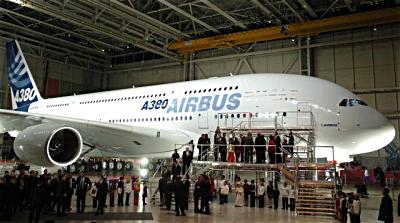
| This was so true 200 year ago when Lord Isaac Newton discovered g while resting in his garden and watching the apples falling. The thing is the knowledge of man kind is growing and growing. People are requested to do things on the run… knowing nothing about them. They simply are able to get the necessary information during the development phase and make there the improvements, find the solutions and yes, invent. Classically, it all should be clear at design time but... the projects are larger and larger. It became somehow utopian to have the entire solutions from the start.This was the case of the world's biggest-ever passenger plane, the Airbus A380. They had two limitations: the time and the resources. | |
 | So nowadays the equation becomes: Time + intelligence + resources = solutions + innovations. We have economical plans, we have budget, so we have deadlines.The resources are limited either by the budget either by simply the real world limits. |
| The ultimate intelligence would be to use at maximum the resources that we have. Look at the picture! Two PET bottles transformed ingenuously into slippers. All the nowadays intelligence signs: limited budged, limited resources, fast implementation and a great solution. Yes, the picture is very funny... but beyond this…I find it brilliant...I think this is the contemporaneous definition of the intelligence. | |
Showing posts with label science. Show all posts
Showing posts with label science. Show all posts
Sunday, November 20, 2005
Contemporaneous definition of human intelligence
 Digg
Digg
 Reddit
 del.icio.us
 Google
Tuesday, April 19, 2005
Early Universe Liquid-Like
Washington, April 18 (Reuters): Scientists using a giant atom smasher said today they have created a new state of matter — a hot, dense liquid made out of basic atomic particles — and said it shows what the early universe looked like for a very, very brief time.
“We think we are looking at a phenomenon ... in the universe 13 billion years ago when free quarks and gluons ... cooled down to the particles that we know today,” Aronson said.
The quark-gluon plasma was made in the Relativistic Heavy Ion Collider — a powerful atom smasher at Brookhaven National Laboratory in Upton, New York. Unexpectedly, the quark gluon plasma behaved like a perfect liquid of quarks, instead of a gas. For their experiment, the researchers smashed two gold ions together at extremely high speeds, very close to the speed of light. The collision was so intense that the strong force that usually binds quarks into protons and neutrons weakened, allowing the quarks to roam freely.
Great news! Big discovery…
Remember from physics what the quarks are?
Quark:
Any of a group of six elementary particles having electric charges of a magnitude one-third or two-thirds that of the electron, regarded as constituents of all hadrons.
Hadron
Any of a class of subatomic particles that are composed of quarks and take part in the strong interaction.
Baryon
Any of a family of subatomic particles, including the nucleon and hyperon multiplets, that participate in strong interactions, are composed of three quarks, and are generally more massive than mesons. Also called heavy particle.
Meson
Any of a family of subatomic particles that participate in strong interactions, are composed of a quark and an antiquark, and have masses generally intermediate between leptons and baryons.
Gluon
A hypothetical massless, neutral elementary particle believed to mediate the strong interaction that binds quarks together.
Interesting definitions! Interesting world! Are we getting the grasp of the state of matters possible in this universe? Are we close to know them all? Probably there no one would think that. Is the quark the smallest electrical charge? Oh… one day… possible someone will prove something else. I think the more physics discovers in the area the more questions appear. So we try to answer and make a step forward, but not very far. It is not possible to look beyond although everyone wishes that.

Wednesday, March 02, 2005
Person authentication
What I see as being the future in person authentication … is... Parameterized Authentication
"Parameterized Authentication moves beyond the traditional approach to security by acknowledging that identity verification cannot always produce perfect results. Our model addresses such inherent imperfections by introducing a metric, the Authentication Parameter, that captures the overall quality of authentication. We define authentication quality in terms of sensor trustworthiness and the accuracy of sensor measurements."
- Authentication in a non-computer based system. (ATM, entrances)
I assume that nobody can imagine that something else then “Biometric readers” will survive over the time. Using only fingerprints, maybe it can fail. Using faces, the same. But doing a combination of face, iris, fingertips and let’s say voice… I think is strong enough. I cannot imagine a way to gather and imitate somehow all this information. Ok: maybe having a clone of the same age. (Oh yes, the voice has a harmonics that can be found beyond how the speaker intonates. Remember the Fourier transform?) Ok, this works perfectly for ATM, for entrances, etc.
Only when you say biometrics… you say a lot of methods…
Of course all these can be done in the Parameterized Authentication terms. - Authentication in a computer based system.
What about the computer authentication? The password can be stolen. Secure connections? Maybe, for a while this will be the way to go.
Want to go further? Ok, unique identifiers, or perhaps chips will be provided. PIN? Yes of course.
Password hardening based on keystroke dynamics?
Why not?
Or perhaps ... graphical password or… signature written with mouse?
We can add also some fingerprints recognition embedded in the keyboard... If you want strong authentication I think the answer is combine in a smart way the basic stuff that we have already.
Oh yes… do again Parameterized Authentication.
It is clear to me that year by year people get tired of making all kind of accounts and remember all kind of passwords. So, web-sites might give you the possibility to authenticate using some third-party internationally certified methods. This third party can send to the portal some basic information like… a customized username, decided by the user, at the first entrance-time.
So, if your account can be accessed only using this third party that is doing sophisticated stuff like
Password hardening based on keystroke dynamics combined with finger prints recognition then you can be sure that nobody ever will be able to still your password…
As a final conclusion, I can say that the password issue is much solvable than the software cracking issue… Any suggestions?
If you want to see a non exhaustive list of the main authentication methods you can visit Password Replacements
article written by… a gooood friend of mine ;)
I shell split things in two directions:
Subscribe to:
Posts (Atom)